
After-Work Tango
Out of the office. Into the embrace.
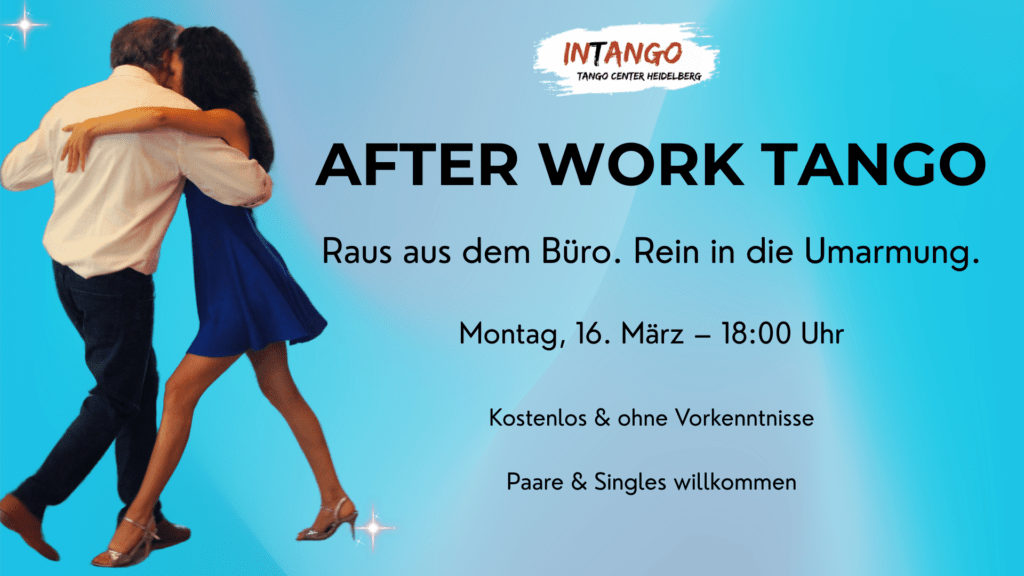
Monday, March 16 · 6:00–7:00 PM
Goldene Rose, Hegenichstraße 10, 69124 Heidelberg
Free. No prior experience. No partner required.
You’ll learn the first steps in Argentine Tango—clearly guided, easy to understand, immediately danceable.
An evening that moves you.
Try it out with no commitment.
Limited spots—registration required.
Secure your spot now: Register here
Beginner Course for Working Professionals
Course starts: Monday, March 23
6:15–7:30 PM
6 sessions
A structured introduction to Argentine Tango—clearly guided, musically grounded, and practical for the dance floor.
Ideal for working professionals who want to learn regularly and efficiently.
Price (per person): €105 / €52.50 reduced
Special price: €89 / €44.50 reduced
for all participants of the trial session on March 16
when registering within 48 hours.
Limited spots.
→ Register for the course now. Register here
Why Tango?
Tango promotes balance, coordination, and body awareness. Studies also show positive effects on mood and stress regulation through music, rhythm, and social interaction.
Scientific basis includes:
Hackney & Earhart (2009), Journal of Neurologic Physical Therapy
Pinniger et al. (2013), The Arts in Psychotherapy
After a workday, tango offers a structured, focused activity—with clear guidance and no performance pressure.
Register now for the free After-Work Tango:
Register here
Good to know:
✔ Drinks and Italian specialties at the bar
✔ Barrier-free access
✔ Free parking directly across the street (Hegenichstraße 2)
✔ Excellent public transport connections
– 9 minutes from Hauptbahnhof Süd (Bahnstadt)
– 19 minutes from Bismarckplatz
Beginner Workshop
Your first step into tango.

✔️ No prior experience required
✔️ Couples & individuals (m/f/d) warmly welcome
✔️ free for students, apprentices & Kulturpass holders
In this beginner workshop, we guide you step by step into the world of Argentine Tango—in a relaxed atmosphere. You’ll learn fundamental movement principles, musical understanding, and partner interaction. The focus is on awareness, connection, and respectful communication in dance.
Tango connects people regardless of origin, language, or social background. This open workshop takes place as part of the International Week Against Racism Heidelberg. Tango itself emerged from cultural diversity and enables an encounter on equal footing through music, improvisation, embrace, and nonverbal communication.
What you’ll learn:
- walking together as a couple to music
- tango embrace & connection
- principles of leading and following
- the base, the rock step, and the ocho
Traditionally in tango, the man leads and the woman follows—but with us, all forms are welcome: women, men, and people of all genders who want to lead or follow, or are simply curious.
Following the beginner workshop, there will be a Chacarera workshop. Chacarera is a traditional Argentine folk dance performed in groups that promotes community and openness. The Chacarera workshop is open to everyone, including external dancers, and is offered on a donation basis.
Afterwards, the Milonga begins, the social tango dance evening.
Saturday, March 14
4:15–6:45 PM Argentine Tango Workshop
6:45–7:30 PM Chacarera – open to all | donation basis
from 7:30 PM Milonga – the social tango dance evening
(open to all, free for workshop participants)
Participation fee (per person): €45 / €22.50 with subscription / €0 for students, apprentices & Kulturpass holders
Location: Goldene Rose, Hegenichstr. 10, 69124 Heidelberg
Registration:
Register now via the registration form.
Couples and individuals are welcome! We will do our best to arrange a dance partner for you.
Q&A:
Here you’ll find the most common questions we receive from beginners about tango, along with our answers.
Stufe 1: Einsteigerstufe
Tango von Anfang an richtig verstehen – Dein Einstieg in eine gelebte Tanzkultur.

✔️ Keine Vorkenntnisse nötig
✔️ Paare & Einzelpersonen (m/w/d) herzlich willkommen
✔️ 50 % Rabatt für Studis & Azubis
Tauche ein in die faszinierende Welt des argentinischen Tangos – in unserem Einsteigerkurs lernst du die essenziellen Grundlagen in entspannter und freundlicher Atmosphäre kennen. Unsere erfahrenen Tangolehrer:innen begleiten dich mit viel Freude, Geduld und Leidenschaft auf deinem Weg in den Tango Argentino.
Deine ersten Schritte bei uns sind so leicht und unbeschwert wie ein Spaziergang am Neckarufer. Denn Tango ist im Wesentlichen das gemeinsame Gehen im Rhythmus der Musik, getragen von der Umarmung.
Was du lernst:
- Die Kunst der Umarmung und Verbindung
- Führen und Folgen mit Klarheit und Feinfühligkeit
- Wiegen, Base, Ocho und eine kleine Drehung
- Die Kultur der Milonga, den sozialen Tanzabend, zu dem du während des Kurses ermäßigten Eintritt genießt
Traditionell führt im Tango der Mann, die Frau folgt – doch bei uns sind alle Formen willkommen: Frauen, Männer und Personen aller Geschlechter, die führen oder folgen möchten, oder einfach neugierig sind.
Die Einsteigerstufe umfasst 6 Einheiten. Der Einstieg ist bis zur zweiten Einheit möglich.
| Datum | Uhrzeit | Tag | Leitung |
| 22. Februar – 29. März | 14.15 – 15.30 Uhr | Sonntag | Penelope & Florian |
| 23. März – 4. Mai (nicht am 6.4.) | 18.00 – 19.15 Uhr | Montag | Simge & Andreas |
| 28. April – 2. Juni | 19.45 – 21.00 Uhr | Dienstag | Mariana & Claudia |
Ort: Goldene Rose, Hegenichstr. 10, 69124 Heidelberg
Teilnahmebeitrag (pro Person): 105 € / 52,50 € ermäßigt
Info zu den Teilnahmegebühren
Anmeldung:
Melde dich jetzt über das Anmeldeformular an.
Paare und Einzelpersonen sind willkommen! Wir bemühen uns, einen Tanzpartner / eine Tanzpartnerin zu vermitteln.
Hier findest du die häufigsten Fragen, die wir von Einsteiger:innen rund um das Thema Tango bekommen, und unsere Antworten darauf.
Refresher Workshop
Back into the embrace: refresh fundamentals, deepen connection.

✔️ Basic prior knowledge required
✔️ Couples & individuals (m/f/d) warmly welcome
✔️ free for students, apprentices & Kulturpass holders
Our refresher workshop is designed for dancers with prior experience and offers the ideal opportunity to deepen the embrace, fundamentals, and connection in tango—as preparation for entering Level 2.
What you’ll learn:
- Review of Argentine Tango fundamentals
- practical introduction to key figures such as Ocho Cortado, Sanguito, and Media Luna
- deepening the embrace and the principle of leading and following
This workshop is suitable for you if you:
- have already attended a basic course/workshop or have some foundational knowledge,
- want to return to tango after a break,
- want to specifically prepare for our Level 2.
Sunday, May 31
11:30 AM–2:00 PM
Location: Goldene Rose, Hegenichstr. 10, 69124 Heidelberg
Participation fee (per person): €45 / €22.50 with subscription / €0 for students, apprentices & Kulturpass holders
Registration:
Register now via the registration form.
Couples and individuals are welcome! We will do our best to arrange a dance partner for you.
Q&A:
Here you’ll find the most common questions we receive from beginners about tango, along with our answers.
Q&A
Frequently Asked Questions About Starting Argentine Tango

We’ve answered the most important questions from beginners clearly and honestly, so you can start with confidence.
1. I don’t have a dance partner—can I still register?
Yes. Individual registrations are always possible. We support partner matching. Often it works out right away, sometimes it takes a bit of patience. What matters is the willingness to engage.
2. Is tango really that difficult?
Tango is considered challenging because it offers many expressive possibilities. However, its core is simple: walking together to music. With just a few fundamentals, you can already experience meaningful dances. At the same time, tango opens space for lifelong development.
3. I’m not athletic—is tango still for me?
Yes. Tango is not a competitive sport, but coordinated movement with moderate intensity. It promotes balance, coordination, and body awareness—even for adults without an athletic background. Breaks are natural and part of tango culture. What matters is attention, not stamina.
4. I have back or knee problems—is tango suitable?
Tango is adaptable and can be varied in intensity and range of motion. If you have existing issues, we recommend consulting your doctor. Feel free to talk to us—we take individual needs into account in class.
5. Am I too old / too young?
Tango has no fixed age limit. People of all generations dance worldwide. What matters is interest, openness, and willingness to learn. Tango promotes concentration, coordination, and social interaction—regardless of age.
6. I have trouble remembering steps—can I still learn tango?
Yes. Tango is not based on choreography. We teach movement principles and clear structures that lead you to improvisation early on. Improvisation comes from understanding, not memorization. “Mistakes” are part of the learning process and expand your possibilities.
7. What happens in the first class specifically?
We start with simple walking exercises, rhythm awareness, and first partner exercises at a calm pace. You’ll be guided step by step—without pressure and without prior knowledge.
8. Do I have to dance with strangers right away?
In class, you usually dance with a fixed partner. Partner rotation may be offered but is voluntary. We maintain a respectful, safe atmosphere.
9. How long does it take until I can dance?
Many experience their first complete dances at a milonga after just a few hours. After 4–6 weeks, you can join in simple dances. After about two to three months of regular classes, most feel confident in the basic repertoire. You can participate quickly—and still deepen your skills for a lifetime.
10. How often should I practice?
One class per week enables continuous development. Those who want to progress faster can add practice evenings or milongas. Regularity is more effective than high intensity in short intervals.
11. What does it cost overall—do I need long-term contracts?
If you’re starting fresh, you typically begin with a single 6-week course. Before new course starts, we often offer free trial sessions so you can get to know us and tango without commitment.
For dancers with prior experience, there’s the option of a trial subscription for one month—with no contract commitment.
If you want to dance regularly, you can choose between subscriptions and flex cards. A long-term commitment is not required to get started. Whether and how you continue is up to you.
12. What should I wear to the first class?
Comfortable, movement-friendly, neat. What’s important is that you can move freely and feel comfortable. There are no other requirements.
13. Do I need special shoes to start?
For the first few weeks, comfortable shoes with a smooth, non-sticky sole (ideally leather or smooth material), good support, and no heavy tread are sufficient. Sneakers often work well. Special tango shoes make sense once you’re dancing regularly—they make turns and precise weight shifts easier. We’re happy to give shoe-buying tips in person.
14. How does leading and roles work?
Traditionally in tango, one person leads and the other follows. With us, all roles are open: women, men, and people of all genders can lead or follow—independent of traditional assignments.
You can explore what feels right for you. Roles can be learned and switched if you’re interested.
15. What is a milonga?
A milonga is a social tango evening. Dancing is to tango, vals, and milonga (music style). Structure, music selection, and clear rules create a respectful framework. It’s not about show, but about lived tango culture: encounter, music, movement. Open to beginners and advanced dancers. You don’t have to dance perfectly to attend a milonga.
16. How erotic is tango?
Tango can feel sensual, but it doesn’t have to. Closeness arises through connection and mutual consent. The embrace can be close or open—depending on the partner, music, and situation. Eroticism is one possible facet, but never a requirement. Respect always comes first. Boundaries are respected.
17. Do I have to dress up?
In class: no.
At special balls or festive milongas: feel free. Elegance in tango is shown through movement quality, musicality, and presence. Clothing can emphasize this, but doesn’t replace it.

