


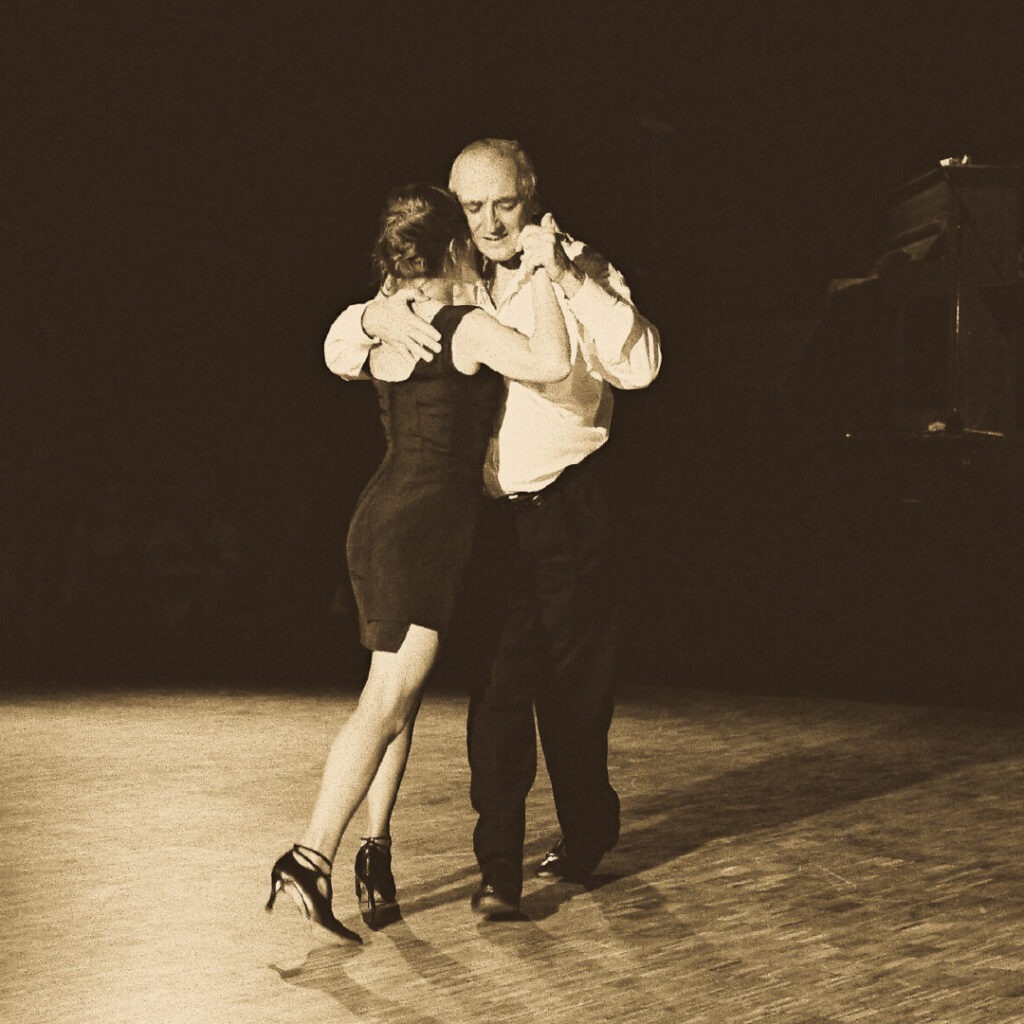
What is Milonguero, actually?
As part of our Tango Marathon Paradiso, I am offering a Milonguero seminar for advanced Tango dancers and marathon dancers. More information at www.marathonparadiso.de/seminar.
Why should one delve into Milonguero?
The following features or advantages can be identified in couples dancing Milonguero:
- Aesthetic, intimate, and beautiful to watch: The couple presents a beautiful, aesthetic image in the Milonga. Especially the women appear elegant, intimate, and often sexy.
- Refined and social dancing: “Milonguero couples” are welcome in the Milongas.
- Intensity of the music: One can dance with variety but not through combinations, rather through the dynamics and intensity of the music.
- The role of the woman: When the music takes precedence, there is ample time for the woman to contribute musically. This enriches the dance and can be very impressive.
- Body control and technique: Dancers who dance a lot of Milonguero can often shape their bodies into a Tango body more effectively. In this way, they can also flexibly switch between styles and are not always confined to Milonguero. Thus, their own way of dancing Tango becomes more diverse.
Who danced Milonguero?
The renaissance of Tango began in the late eighties. Which old Milongueros were there at that time? The most famous are Antonio Todaro, Pepito Avellaneda, Pupi Castello, Eduardo Arquimbau, Carlos Copes, Mingo Pugliese, and Carlos Gavito. However, none of them danced what is now understood as Milonguero. There is a clip where many older couples in Buenos Aires dance Tango. Initially, you cannot tell their age by their feet until you see their faces. A very impressive clip. What stands out is that not a single couple among them is dancing Milonguero.
Later, dancers like Tete and Dante came into contact with the close style. Carlos Gavito also occasionally used this style in his show to add a dramatic touch to his dance. To my knowledge, the term “Milonguero” did not exist from the beginning. It only became established later, although it was not consistently used.
What is the Milonguero style exactly?
The term is now used very broadly and imprecisely. Often, it refers to dancing closely in the Milonga, to salon-appropriate Tango, to Tango in the salons of Buenos Aires, or to rhythmically danced Tango. Many use terms like “Tango de Salon,” “Tango-Club,” “Tango de Pista,” and “Social Tango” as synonyms for Milonguero. Some even confuse Milonguero with minimalist dancing.
However, all these meanings and characteristics do not describe a style. In the Milonga, one can dance both closed and open. Even in a close embrace, different styles are possible – with partial or full upper body contact. Even with full contact, one can stand differently in the embrace: Each can stand on their own, or a common structure is defined with both partners more or less leaning toward each other with their upper bodies.
I first heard the term in the early 90s from Juan Lange. But at that time, it was far from clear what should be understood by it. Juan initially understood Milonguero as an open style to distinguish it from a closed style he called “Tango de Salon” – but he soon abandoned the term.
I invited Tete, now considered by many as the pope of the Milonguero style, to Heidelberg and Stuttgart several times and worked with him. Even then, we didn’t know what to call this style. Initially, Tete himself referred to it as “Tango de Salon,” later revising it to “Tango-Milonguero.” In the mid-90s, Susanna Miller and Dante used and popularized the term “Milonguero,” referring to the close, rhythmic Tango, the social Tango danced in the salons of Buenos Aires (see also Wikipedia). However, most old Milongueros from Buenos Aires did not dance the Tete style or Milonguero according to Susanna Miller and Dante.
Some dance couples from the Netherlands (Nijmegen/Utrecht) cultivated Tete’s style, calling it “Milonguero” and making it popular in Europe. I align with colleagues from Holland and use the term “Milonguero” for the Tete style because it is precisely defined. Tete’s style is unique. It is characterized, unlike any other style, by a tilted embrace and full contact, where the woman almost lies on the man’s upper body, sometimes even on his stomach. Yet, the embrace is very flexible. Walking and turning in this style are shaped differently due to the embrace.
Who still dances Milonguero today, and what does the future hold?
If I look around today, I find very few couples who dance “correctly” Milonguero (in the sense of Tete). The term “Milonguero” is on everyone’s lips. People exclusively dance in a close embrace at “Encuentros” or also at “Marathons.” However, even if the couples dance disciplined, attentively, and refined, very few of them dance Milonguero according to the above definition. Even among younger professional dance couples, I can only think of a few.
However, in the few couples that master and cultivate the “Milonguero style,” it can also be observed that much development has taken place in the last 10 to 20 years. I would say that Tango has gained many new insights, primarily incorporated into the two styles “Milonguero” and “Nuevo.” Thus, Milonguero is by no means a dusty way of dancing.
Milonguero is, therefore, not comparable at all to dance couples that start their dance with a side step, then move forward with large melodic steps, occasionally stopping the woman with the right or left – often waiting, then striding again – and occasionally dancing small rhythmic steps and the occasional large turn. I consider this way of dancing more as “classic salon” (my designation). Classic because, in my opinion, little development has taken place here. Tango teachers who teach this way of dancing talk a lot about expression, posture, and axis. I must admit that I have never liked this type of Tango. To me, it differs little from classical show dancers. In classical shows, additional elements are added, such as Enrosques, Ganchos, and Boleos, often danced forcefully and quickly. I am neither a fan of classic “Salonistas” nor classic show dancers. This way of dancing seems static, inflexible, and sometimes harsh to me.
This is my personal view, and certainly, it’s a matter of taste. I don’t want to criticize any style. Ultimately, everything is Tango, and Tango thrives on diversity. However, I want to explain why I can be more enthusiastic about the Milonguero style and the Nuevo style. The similarities between Milonguero and Nuevo are astonishing. Both styles are characterized by flexibility, elasticity, and continuity. Therefore, both styles can be well combined; one can transition from one to the other. Moreover, they are particularly versatile, creative, and modern.
And most importantly: The dance couple is alive! I am convinced that the future belongs to the two directions “Milonguero” and “Nuevo,” and the mixing of different styles will occur even more strongly.
Sources:
www.en.wikipedia.org/wiki/Milonguero_style
© Copyright 2018 Emile Sansour